
Your performance will be evaluated
across five core pillars that represent
a holistic view of circularity. Each
pillar is weighted to reflect its
impact on building a truly circular
system.
Side Note: For service sectors, "Product" indicators are adapted to apply to service assets, consumables, packaging and facilities
Side Note: For service sectors, "Product" indicators are adapted to apply to service assets, consumables, packaging and facilities
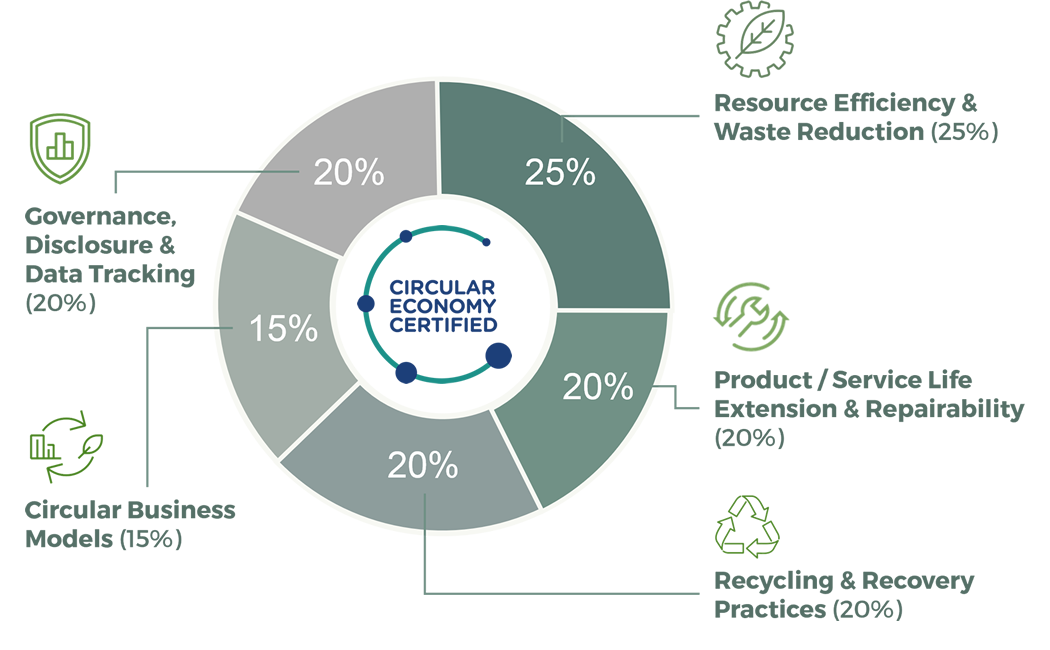

Pillar 1: Resource Efficiency & Waste Reduction (25%)
Intent:
To reduce raw material, energy, and water consumption and eliminate waste at its source.
Core Criteria:
- Material Efficiency Management: Tracking material use intensity and implementing reduction initiatives.
- Energy Efficiency: Monitoring energy use and executing efficiency projects.
- Water Efficiency: Tracking consumption and implementing reduction/reuse initiatives (where relevant).
- Waste Prevention & Lean Process: Using lean principles (e.g., Kaizen) to reduce defects, overproduction, and waste at the source.
- Hazardous/Scheduled Waste Controls: Ensuring proper storage, labelling, and licensed disposal (if applicable).
Minimum Expectation by Level:
Bronze: Basic tracking +at least 1 documented reduction initiative.
Silver: Established targets +multiple initiatives +measurable improvement.
Gold: Systematic management +strong intensity improvements +innovative practices.

Pillar 2 - Product/Service Life Extension & Repairability (20%)
Intent:
Extend useful life, reduce replacement frequency, and enable repair, refurbishment, or reuse.
Core Criteria:
Durability & Lifecycle Thinking, Repairability & Maintenance Systems, Reuse/Refurbishment/Redeployment, Packaging Reduction, Customer Enablement (e.g.,take-back schemes).
Service Sector Example:
IT equipment lifecycle extension, reusable consumables, digitised documents.

Pillar 3 - Recycling & Recovery Practices (20%)
Intent:
Divert waste from landfill and build effective recovery loops and partnerships.
Core Criteria:
Waste Segregation Quality, Licensed Recycling Partnerships, Waste Diversion Rate Tracking, Internal Recycling/Recovery, Organic Waste Management.
Minimum Expectation:
Bronze requires segregation and licensed recycler evidence;
Silver requires diversion tracking;
Gold requires high diversion performance.

Pillar 4 - Circular Business Models (15%)
Intent:
Shift from linear "sell-and-dispose" to models that keep value circulating.
Core Criteria:
Reuse/Refill Models, Leasing/Subscription/Product-as-a-Service, Reverse Logistics, Industrial Symbiosis, Circular Procurement.
Service Sector Emphasis:
Leasing shared equipment, subscription services, circular procurement.

Pillar 5 - Governance, Disclosure & Data Tracking (20%)
Intent:
Make CE auditable, managed, and continuously improved with data integrity.
Core Criteria:
CE Governance Roles, CE Policy & Objectives, Data Tracking Systems, Training & Competency, Disclosure/Communication, Corrective Action & Improvement.
Minimum Expectation:
Bronze requires a policy and basic records;
Silver requires targets and training;
Gold requires a KPI dashboard and verified improvements.